
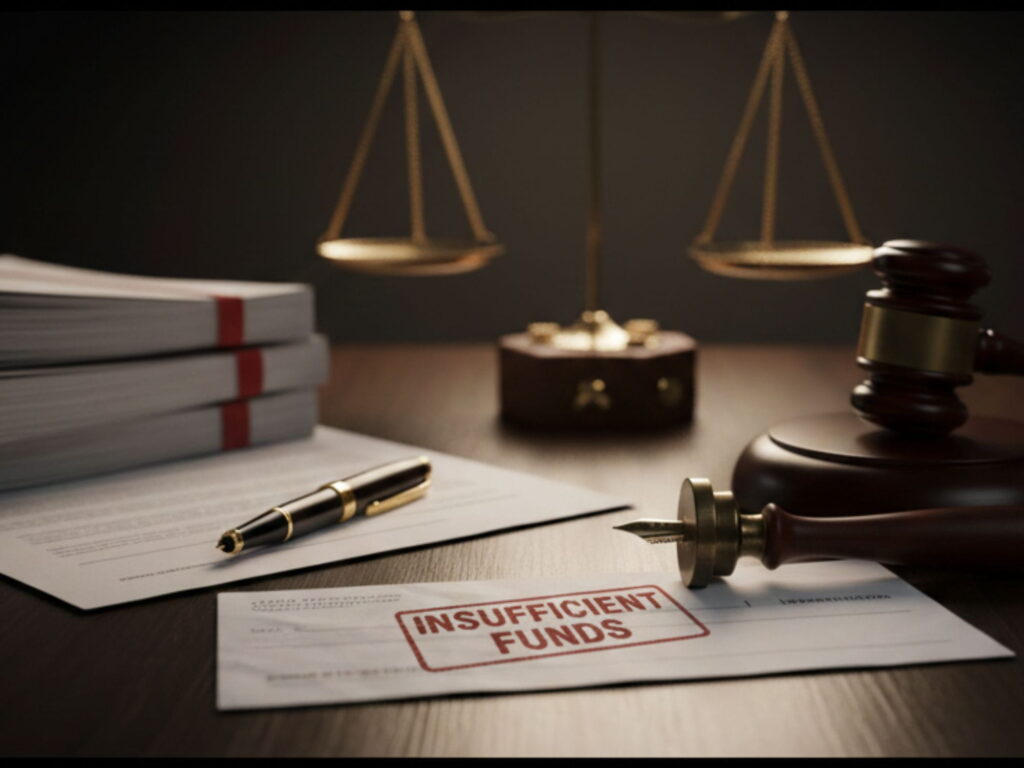
A cheque is commonly used for business payments, loans, personal transactions and settlement of financial obligations. When a cheque is returned unpaid by the bank it can create serious legal and financial consequences. Under the Negotiable Instruments Act, 1881 a cheque dishonour may result in criminal proceedings when the statutory requirements are satisfied.
A Cheque Bounce Lawyer in Delhi High Court can assist individuals, businesses and companies in matters involving dishonoured cheques, statutory notices, complaints under Section 138 of the Negotiable Instruments Act and appeals or other proceedings before higher courts.
Cheque bounce cases are highly time-sensitive because the law prescribes specific requirements concerning the bank return, legal notice, payment period and filing of the complaint. Missing a statutory deadline can affect the maintainability of the case.
This guide explains the cheque bounce process in Delhi and the legal remedies available to both complainants and accused persons.
Key Takeaways
- A cheque dishonour can attract criminal liability under Section 138 of the Negotiable Instruments Act when statutory conditions are fulfilled.
- The payee generally needs to issue a written demand notice within the prescribed period after receiving information about dishonour.
- The drawer gets a statutory period to make payment after receiving the demand notice.
- A complaint under Section 138 must be filed within the applicable limitation period subject to the law relating to condonation of delay.
- Both complainants and accused persons have legal rights and available remedies.
- Professional legal assistance can be particularly useful when the matter involves multiple transactions, substantial amounts or proceedings before the Delhi High Court.
What Is a Cheque Bounce Case?
A cheque bounce occurs when a bank returns a cheque unpaid.
The reason may include:
- Insufficient funds
- Account closure
- Payment stopped by the drawer
- Signature-related issues
- Exceeding account arrangements
- Other reasons recognised under banking and applicable legal principles
Not every dishonoured cheque automatically results in criminal liability.
For Section 138 of the Negotiable Instruments Act to apply the statutory conditions must be satisfied.
The Supreme Court has repeatedly dealt with the requirements of Section 138 and the legal principles governing cheque dishonour proceedings.
What Is Section 138 of the Negotiable Instruments Act?
Section 138 of the Negotiable Instruments Act deals with the dishonour of cheques for insufficiency of funds or where the amount exceeds the arrangement with the bank.
The provision can result in imprisonment which may extend to two years or fine which may extend to twice the amount of the cheque or both subject to the statutory requirements.
The important point is that cheque dishonour alone is not enough.
The statutory conditions must be satisfied before criminal liability under Section 138 can arise.
Essential Requirements for a Cheque Bounce Case
A typical Section 138 case involves several important requirements.
1. Cheque Issued for a Legally Enforceable Debt or Liability
The cheque should have been issued towards a legally enforceable debt or other liability covered by the provision.
2. Presentation Within the Applicable Period
The cheque must be presented within the period prescribed under the applicable law and banking rules.
3. Dishonour by the Bank
The cheque must be returned unpaid.
4. Statutory Demand Notice
The payee or holder in due course must issue a written demand notice within the statutory period after receiving information about dishonour from the bank.
5. Failure to Make Payment
The drawer must fail to make the required payment within the statutory period after receiving the notice.
6. Complaint Within Limitation
The complaint must be instituted within the prescribed limitation period subject to applicable provisions concerning delay.
Because each step has legal significance a cheque bounce case should be handled carefully from the beginning.
What Should You Do After a Cheque Is Dishonoured?
If your cheque has been dishonoured the first step should be to preserve all relevant documents.
These may include:
- Original cheque
- Cheque return memo
- Bank statements
- Invoice
- Loan agreement
- Sale agreement
- Purchase orders
- Account statements
- Emails
- WhatsApp or other relevant communication
- Previous payment records
The legal notice should clearly identify the transaction and the amount claimed.
A vague or inaccurate notice can create avoidable complications later.
Cheque Bounce Legal Notice
The statutory notice is one of the most important stages of a Section 138 proceeding.
The notice generally demands payment of the cheque amount and communicates the legal consequences of non-payment.
The notice should be drafted carefully and should correspond with the underlying transaction and bank records.
It is important to preserve evidence showing:
- Date of notice
- Contents of notice
- Dispatch details
- Delivery information
- Returned postal envelope where applicable
- Electronic communication where legally relevant
A Cheque Bounce Lawyer in Delhi High Court can review the transaction and prepare a notice that addresses the statutory requirements.
What Happens After the Legal Notice?
Once the statutory notice is served the drawer gets the period prescribed under Section 138 to make payment.
If payment is made within the statutory period the criminal complaint under Section 138 may not arise on that dishonour subject to the facts and legal position.
If payment is not made the complainant may initiate proceedings before the appropriate court within the prescribed limitation period.
Where Is a Cheque Bounce Case Filed in Delhi?
Jurisdiction in cheque dishonour cases is governed by statutory provisions and judicial decisions.
Section 142 of the Negotiable Instruments Act contains provisions concerning cognizance and procedure while Section 142(2) addresses territorial jurisdiction in specified circumstances.
The appropriate court depends on factors such as the manner of presentation of the cheque and the location of the relevant bank branch or account as provided under law.
Because jurisdiction can become a contested issue it is advisable to determine the correct court before filing the complaint.
Cheque Bounce Cases and the Delhi High Court
The Delhi High Court may become relevant in cheque bounce matters in several situations.
These can include:
- Criminal revisions where legally maintainable
- Petitions seeking appropriate relief
- Challenges to orders of subordinate courts
- Bail-related proceedings in appropriate circumstances
- Appeals where provided by law
- Quashing petitions under appropriate jurisdiction
- Procedural challenges
The High Court does not ordinarily function as the trial court for every cheque bounce complaint.
The complaint generally proceeds before the competent Magistrate or other court having jurisdiction.
Therefore anyone searching for a Cheque Bounce Lawyer in Delhi High Court should first understand whether the matter is at the trial stage or whether a High Court remedy is actually available.
Can a Cheque Bounce Case Be Quashed?
In appropriate circumstances a person may seek quashing of criminal proceedings before the High Court under its applicable jurisdiction.
However quashing is not a routine remedy simply because the accused disputes the allegations.
The court examines the facts, legal grounds and applicable principles before deciding whether intervention is justified.
Where the parties have reached a genuine settlement the legal strategy may be different.
A lawyer should review the complaint, documents, settlement terms and procedural stage before advising on the appropriate remedy.
Defence in a Cheque Bounce Case
A person accused under Section 138 has legal rights and can contest the allegations.
Possible areas of defence may include:
- Absence of legally enforceable debt
- Improper statutory notice
- Failure to satisfy statutory requirements
- Dispute concerning issuance of the cheque
- Payment already made
- Material inconsistencies in the complainant’s case
- Lack of proper authority
- Jurisdictional issues
- Other facts affecting the presumption or liability
The defence must be based on the evidence and circumstances of the individual case.
A person should not assume that every cheque bounce allegation automatically results in conviction.
Presumption Under the Negotiable Instruments Act
Sections 118 and 139 of the Negotiable Instruments Act contain statutory presumptions relevant to negotiable instruments and cheques.
In a Section 138 proceeding the law can create a presumption in favour of the holder concerning the cheque and the underlying liability subject to the statutory framework.
However such presumptions are rebuttable.
The accused may seek to establish a legally acceptable defence based on the evidence and circumstances.
This is one reason why the quality of the documentary record can be extremely important in cheque bounce litigation.
Bail in Cheque Bounce Cases
Cheque dishonour proceedings are criminal proceedings under the applicable statutory framework.
Depending on the procedural stage and circumstances an accused may need to address questions concerning appearance, exemption, bail or other procedural relief.
A person should not ignore summons from the court.
If an accused has received a summons the appropriate response depends on the contents of the order and the stage of the proceeding.
An experienced lawyer can assess whether bail, exemption from personal appearance or another procedural remedy may be appropriate.
Can a Cheque Bounce Case Be Settled?
Yes.
Cheque bounce cases can often be resolved through settlement depending on the circumstances and applicable legal procedure.
A settlement may involve:
- Payment of the cheque amount
- Interest
- Agreed compensation
- Withdrawal or disposal of proceedings
- Other mutually agreed terms
The settlement should be properly documented.
Parties should avoid relying only on informal oral assurances.
The legal effect of settlement also depends on the procedural stage of the case and the orders required from the court.
Compensation in Cheque Bounce Cases
The complainant may seek appropriate compensation and other reliefs available under law.
The court can consider compensation-related provisions under the Code of Criminal Procedure and other applicable statutory provisions.
In some circumstances courts may also consider interim compensation under Section 143A of the Negotiable Instruments Act subject to the statutory conditions.
The exact relief depends on the facts and procedural stage.
Documents Required for a Cheque Bounce Case
A complainant should generally preserve:
- Original dishonoured cheque
- Cheque return memo
- Bank statement
- Statutory legal notice
- Proof of dispatch
- Proof of service
- Invoice or agreement
- Ledger account
- Loan documents where applicable
- Relevant correspondence
- Payment records
- Details of previous transactions
An accused should similarly preserve documents that support the defence.
These may include:
- Bank statements
- Payment receipts
- Agreements
- Emails
- Messages
- Account statements
- Correspondence concerning the transaction
- Evidence showing the purpose for which the cheque was issued
Cheque Bounce and Business Transactions
Cheque dishonour cases are common in commercial transactions.
Businesses should maintain proper records for:
- Sales
- Purchases
- Loans
- Advances
- Security cheques
- Invoices
- Receivables
- Payments
- Credit arrangements
A cheque issued as security can raise specific legal questions depending on the facts and the circumstances in which it was presented.
Businesses should therefore avoid treating every cheque transaction as identical.
Common Mistakes in Cheque Bounce Cases
Delaying the Legal Notice
The statutory notice must comply with the applicable time requirement.
Filing in the Wrong Jurisdiction
Territorial jurisdiction should be checked before filing.
Losing the Original Documents
The original cheque and bank return memo can be important evidence.
Sending an Inaccurate Notice
The notice should accurately reflect the transaction and amount claimed.
Ignoring Court Summons
Ignoring a court summons can create unnecessary procedural difficulties.
Assuming Settlement Is Automatic
A private settlement does not necessarily mean that a pending criminal proceeding automatically disappears without following the appropriate legal process.
Using Aggressive or Unnecessary Language
A legal notice should focus on facts, liability and statutory requirements rather than emotional allegations.
Expert Insights on Cheque Bounce Litigation
A successful cheque bounce case is generally built around documents, statutory compliance and a clear transaction history.
For a complainant the first priority should be establishing:
Transaction → legally enforceable liability → cheque issuance → presentation → dishonour → statutory notice → non-payment → timely complaint
For an accused the focus should be on examining the transaction and testing whether the statutory requirements and alleged liability are actually established.
Business owners should also distinguish between ordinary payment cheques and security cheques because the factual circumstances surrounding issuance and presentation can become important.
If the cheque relates to a large commercial transaction the underlying contract, invoices, ledger and bank records should be reviewed together rather than treating the cheque in isolation.
People Also Ask About Cheque Bounce Cases
What does a Cheque Bounce Lawyer in Delhi High Court do?
A Cheque Bounce Lawyer in Delhi High Court can assist complainants and accused persons with Section 138 proceedings, legal notices, bail, settlement, quashing petitions, revisions and other appropriate High Court remedies.
What happens when a cheque bounces?
If the statutory requirements are satisfied the payee can issue a demand notice and may initiate a Section 138 complaint if the drawer fails to make payment within the prescribed period.
How long do I have to send a cheque bounce notice?
The statutory demand notice generally has to be issued within the period prescribed under Section 138 after receiving information from the bank about the dishonour.
Can I go to jail for a cheque bounce case?
Section 138 provides for imprisonment which may extend to two years or fine which may extend to twice the cheque amount or both subject to the statutory requirements and outcome of the case.
Can a cheque bounce case be settled?
Yes. Parties can settle cheque bounce disputes subject to the applicable legal procedure and the stage of the proceedings.
Can an accused challenge a cheque bounce case in the Delhi High Court?
In appropriate circumstances an accused may seek relief before the Delhi High Court. The maintainability and appropriate remedy depend on the facts and procedural stage.
Is a cheque bounce a criminal offence?
Dishonour of a cheque can constitute an offence under Section 138 of the Negotiable Instruments Act when the statutory conditions are satisfied.
Can I recover money through a cheque bounce case?
Section 138 proceedings can create criminal liability for qualifying cheque dishonour. Depending on the circumstances other civil or commercial remedies for recovery may also be available.
Why Choose a Cheque Bounce Lawyer in Delhi High Court?
Cheque bounce disputes can appear straightforward but procedural mistakes can have significant consequences.
Professional legal assistance can help with:
- Reviewing the underlying transaction
- Drafting statutory notices
- Determining jurisdiction
- Filing Section 138 complaints
- Responding to complaints
- Bail and procedural applications
- Settlement negotiations
- Quashing proceedings where legally appropriate
- High Court litigation
- Appeals and revisions where maintainable
For legal assistance relating to cheque bounce matters and proceedings before the Delhi High Court you can visit Ajay Pratap Singh & Associates at ajaypratapsinghandassociates.com.
Conclusion
A Cheque Bounce Lawyer in Delhi High Court can help individuals and businesses navigate the complex procedural and legal requirements associated with dishonoured cheques.
From issuing the statutory notice to filing a complaint and defending an allegation under Section 138 each stage requires attention to deadlines, documentation and applicable law.
If you have received a cheque bounce notice or your cheque has been dishonoured it is advisable to act promptly. Preserving documents, understanding the underlying transaction and obtaining professional legal advice can help protect your interests.
For professional assistance with cheque bounce litigation in Delhi you can visit Ajay Pratap Singh & Associates at ajaypratapsinghandassociates.com.
Disclaimer: This article is provided for general educational and informational purposes only. It does not constitute legal advice. The law relating to cheque dishonour is subject to statutory amendments and judicial interpretation. The appropriate legal remedy depends on the facts and circumstances of each case.
FAQ Schema-Ready Questions & Answers
Question 1: What is a Cheque Bounce Lawyer in Delhi High Court?
Answer: A Cheque Bounce Lawyer in Delhi High Court handles legal matters involving dishonoured cheques including Section 138 complaints, statutory notices, bail, settlement, quashing proceedings and appropriate High Court remedies.
Question 2: What is Section 138 of the Negotiable Instruments Act?
Answer: Section 138 deals with cheque dishonour in specified circumstances involving insufficiency of funds or exceeding the bank arrangement. Criminal liability arises only when the statutory requirements are satisfied.
Question 3: How long do I have to send a cheque bounce notice?
Answer: The statutory demand notice generally must be issued within the period prescribed by Section 138 after receiving information from the bank about the cheque dishonour.
Question 4: Can a cheque bounce case be settled?
Answer: Yes. A cheque bounce case can generally be settled subject to the applicable legal procedure and the procedural stage of the case.
Question 5: Can a cheque bounce case be challenged in the Delhi High Court?
Answer: In appropriate circumstances a party may seek relief from the Delhi High Court. The correct remedy depends on the facts, the order being challenged and the procedural stage.
Question 6: Can an accused get bail in a cheque bounce case?
Answer: Depending on the circumstances and procedural stage an accused may seek appropriate bail or other procedural relief. The court determines the matter according to applicable law.
Question 7: Is every bounced cheque a criminal offence?
Answer: No. Criminal liability under Section 138 arises only when the statutory requirements are fulfilled including the requirements concerning legally enforceable liability, notice and non-payment.
Question 8: What documents are required for a cheque bounce case?
Answer: Important documents may include the original cheque, bank return memo, statutory notice, proof of service, agreements, invoices, account statements, bank records and relevant correspondence.